Top 5 Legal Practice Management Software in Nepal (2026)
 SEO Specialist
Choosing law firm management software in Nepal is harder than it sounds. Most tools are built for international use with unfamiliar workflow and higher pricing. Over that, a software built for Nepali practice is SO rare! But what if I say there’s a law practice management software, built exactly for the lawyers and law firms of Nepal. A scalable, flexible, and fully customizable solution made by a team of Nepalese lawyers, developers, and designers? Yes! This guide talks about the only trusted law firm management software in Nepal, Kanunsoft, which highlights Nepal-focused workflows. We’ll also look at four popular international options: Clio, MyCase, PracticePanther, and PathLegal. So get ready to find, analyse, and choose the best one out of top 5 law firm management systems in Nepal, the one made for your particular workflow. Let’s read on!
Why Nepalese Law Firms Need Practice Management Software
Nepalese law firms need practice management software because it keeps cases, hearing dates, client details, documents, and fees in one place, which helps prevent missed tareeks and lost files. It also lets everyone on the team see the same information, so work doesn’t stall when one person is away or a hearing moves.
Here is how lawyers and law firms benefit with a practice management system:
- Find any document in seconds, no more endless scrolling & searching.
- See every case’s status in a glance, with all details clearly organized.
- Send hearing reminders by SMS or email to your clients. Zero calendaring-scheduling hassle.
- Easily assign tasks to your team and check progress from one screen.
- Handle more cases without losing track. Each case keeps its own hearings and documents.
- Choose who on your team can see each file, complete access control.
- See pending fees and unpaid bills at once. Every invoice is linked to its case, so nothing gets missed.
You can even use Legal CRM to record and manage your leads. It helps you track cases & enquiries, update follow ups, and manage your relationship with clients. Basically, a solution to handle the business side of your law practice.
While you seek such practice management solutions, Nepal adds its own needs. Many firms use Bikram Sambat (BS) dates and plan their work around court tareeks. For that reason, the software you pick should fit how your firm already works. With that in mind, let's look at the five options.
Top 5 Law Firm Management Software in Nepal
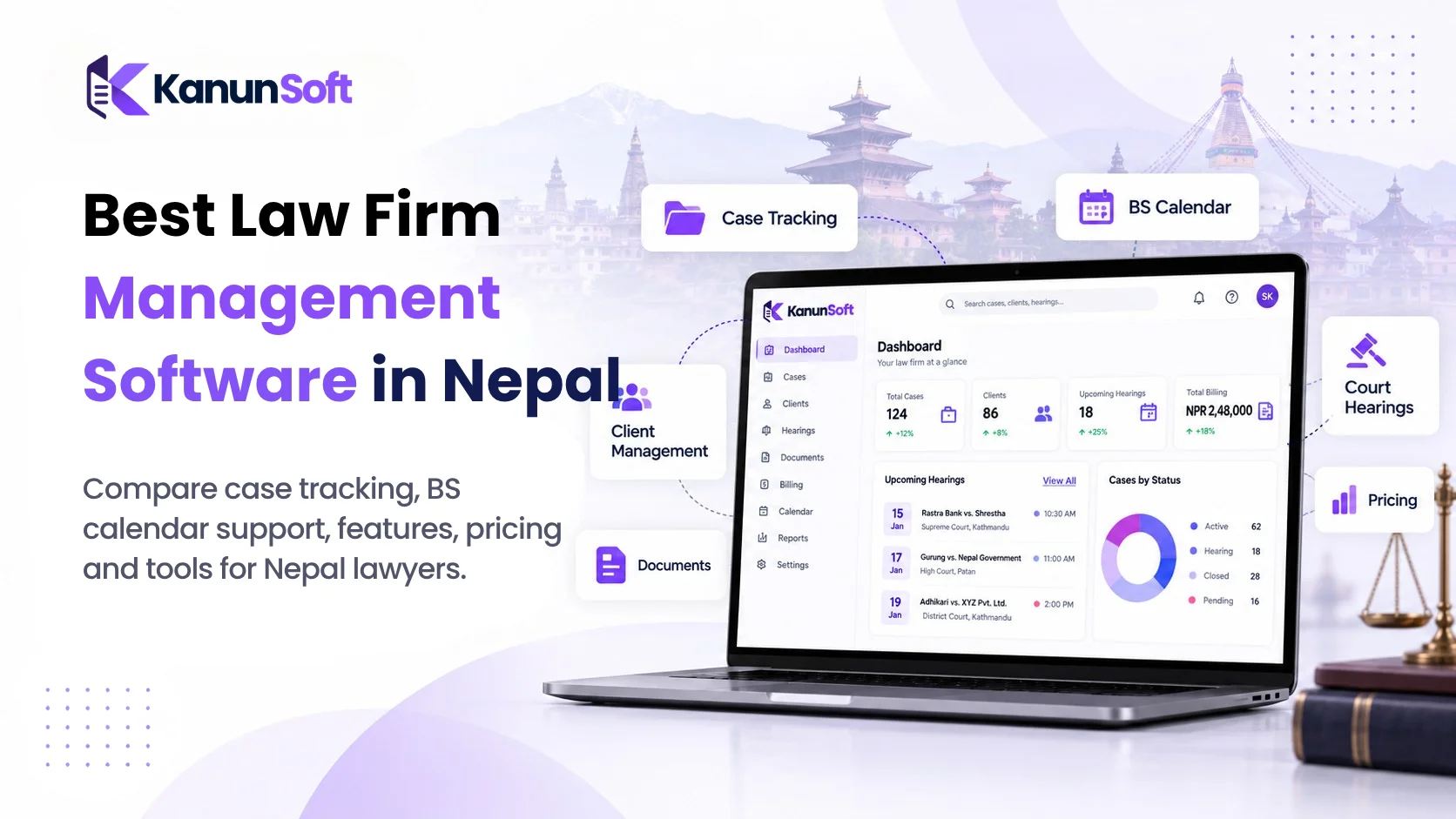
KanunSoft is a strong choice for Nepalese law firms, with case, client, document, calendar, and billing tools in one platform, and it highlights Nepal-focused workflows. Clio, MyCase, PracticePanther, and PathLegal are also well-known options, but they are international tools used by law firms around the world and built mainly for other markets. We’ve talked about each system in detail below:
1. KanunSoft: Law Practice Management Software Built for Nepal
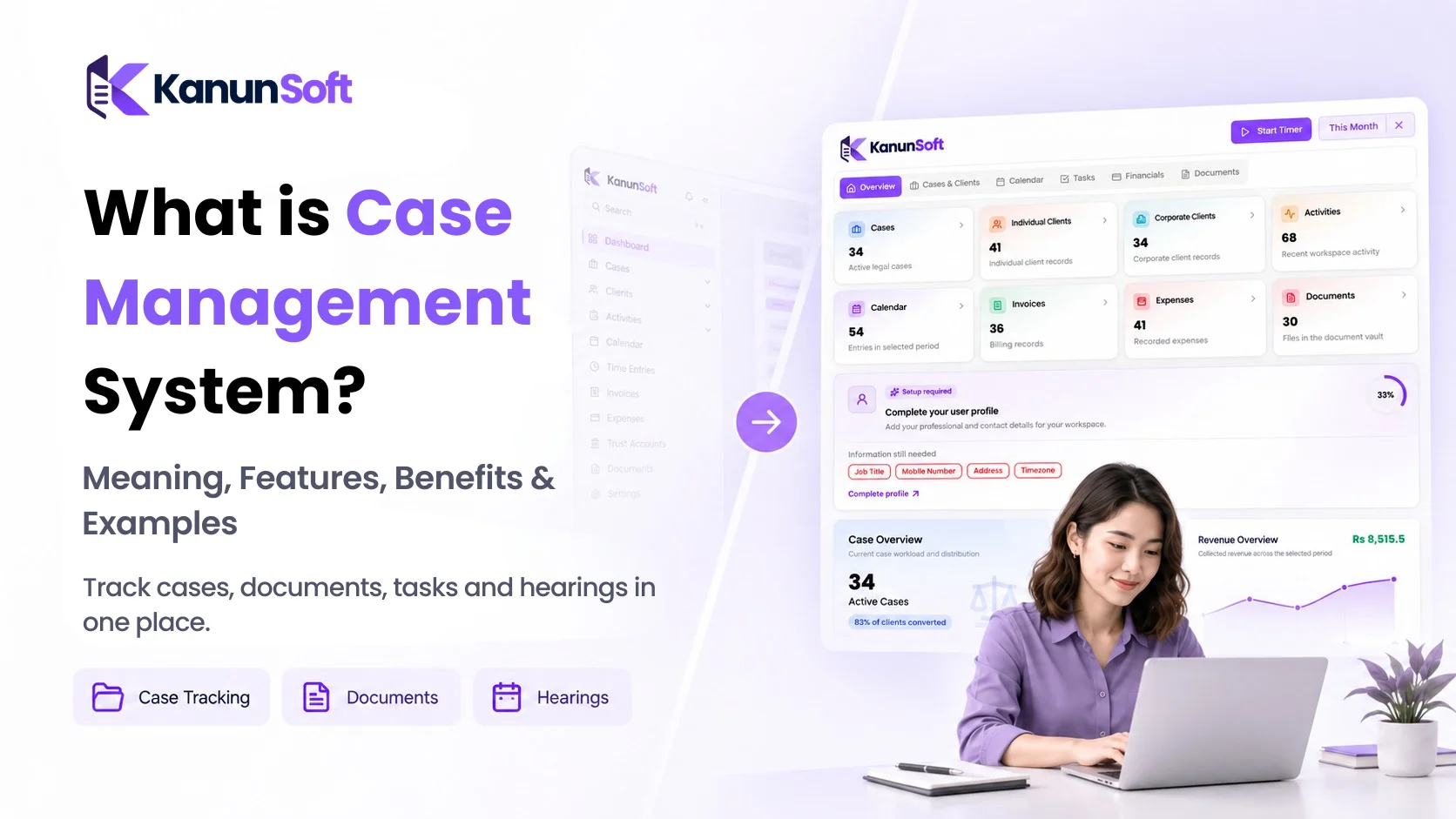
KanunSoft is cloud-based legal practice management software for solo lawyers, small firms, and larger legal teams. It brings case management, client records, documents, deadlines, and billing together in one workspace.
Key features:
- Case and client management: Track matters from intake to closing, with timelines, client profiles, linked documents, intake tools, and a client portal.
- Document management: Store files centrally, use templates, and maintain version history to keep case documents organized.
- Calendars and deadlines: Manage hearings, deadlines, and team tasks with email and SMS reminders. Two-way syncing with Google Calendar and Outlook helps keep schedules up to date.
- Billing and expenses: Track billable time, generate invoices, and record expenses, including court fees, alongside the relevant matter.
If local fit is your top concern, KanunSoft is a sensible first stop. You can explore its features or request a demo and test it with a real case. Watching a full demo is simply the best way to compare your options.
2. Clio
Clio is a large, well-known platform that covers case management, calendaring, documents, billing, and trust accounting. It also lists 300+ integrations, which is a big plus for firms that want a wide tool ecosystem. In addition, Clio says it serves users in 130+ countries and offers migration help and training.
That said, a few questions matter for Nepal. Does it support BS dates? What does the subscription cost in your currency? Can you pay from Nepal? Finally, is support available in your time zone? This last one matters because Clio lists its sales hours in US Eastern time.
3. MyCase
If client communication is your main pain point, MyCase is worth a look. It keeps cases, clients, documents, and billing together, and its website highlights intake forms, a client portal, texting, document templates, e-signatures, time tracking, and invoicing. Together, these can make daily client updates much smoother.
Before you commit, though, check how its payment tools work outside the US. The payment service is built around US banking, including IOLTA rules, so it may not help a Nepali firm. Likewise, ask about BS dates, local court workflows, and pricing in your currency. Then confirm what support looks like for your working hours.
4. PracticePanther
While MyCase leans on client communication, PracticePanther leans on automation. It offers matter management, calendaring, time and expense tracking, billing, and workflows that create tasks automatically. This can help firms with repeat admin work, such as the same steps for every new case.
Still, there are things to confirm. Its payment tools mention US-style methods like ACH and eCheck, so check what works from Nepal. In the same way, ask about date handling, integrations, pricing, and support. Also keep in mind that the website lists a 7-day free trial, which is short, so plan your test before you sign up.
5. PathLegal
Last on our list is PathLegal, which is a different kind of option. It presents itself mainly as a global lawyers' directory that also offers legal case management software. That may suit independent lawyers who want basic case organization. However, its public pages did not clearly explain current free access, features, or plan limits.
Because of that, check a few things first: what is free today, what is limited, how your data is protected, how backups work, and whether you can export your data. In short, never assume an old free offer still exists. With all five tools covered, let's put them side by side.
KanunSoft vs. Other Law Practice Management Software for Nepal
The right choice depends on workflow fit, features, cost, support, and how easily you can leave later. KanunSoft stands out as a compelling choice for Nepalese law firms seeking practice management software aligned with their local workflows. KanunSoft offers a Nepal-focused solution with Bikram Sambat dates, legal processes, and billing requirements,
To make the comparison easier, the table below shows what is confirmed and what you should verify.
| Factor | KanunSoft | International alternatives |
| Nepal-specific legal workflows | Supports Bikram Sambat (BS) calendar dates, Nepali date and time, court hearing schedules, and taarekh alerts. | Confirm support for BS dates, Nepali legal terminology, and Nepal’s court procedures. |
| Case and client management | Manage cases, matters, client profiles, contacts, case progress, and related records in one place. | Clio and MyCase offer case and client management, including intake and client portals. |
| Documents, hearings, and reminders | Organise legal documents, manage hearing dates and deadlines, use document templates, receive SMS and email reminders, and sync with Google Calendar. | Similar tools are available, but local date formats and court scheduling may differ. |
| Pricing and payments | Offers a free plan and paid plans starting at $149 per year, with pricing published in USD. | Compare subscription prices, billing currencies, and payment options available in Nepal. |
| Training and customer support | Support and onboarding options vary by plan. | Support availability depends on the provider, plan, and service hours. |
| Software maintenance and data access | The provider maintains the software and its updates. | Providers maintain their platforms under their respective service terms. Data export options vary by vendor. |
So what does the table tell us? First, local fit matters because a tool that ignores BS dates creates extra work every day. Second, total cost is more useful than the subscription price alone, since training, migration, and add-ons add up. Third, security, onboarding, and data export should weigh as much as features do.
Taken together, KanunSoft deserves priority when Nepal-focused needs come first. On the other hand, an international tool can still win if its features match your firm. Next, there is one more big decision to make: buy ready-made software or build your own.
Buying Law Firm Software vs. Building Your Own
Law firms in Nepal have two main options when adopting management software: purchase an existing solution or hire a development team to build one from scratch. Buying software is generally faster and requires less initial investment, while custom development offers greater control over features and workflows but comes with higher costs and ongoing responsibilities.
1. Buying Ready-Made Law Firm Software
Purchasing software such as KanunSoft gives your law firm access to an existing system without the time and expense of developing one from scratch. You can use features designed for legal work, including case management, client records, document management, scheduling, task management, and billing.
Key advantages of buying ready-made software include:
- Faster implementation: Start using existing features without waiting for a full development cycle.
- Lower upfront costs: Avoid hiring a development team to build the entire system.
- Ready-made features: Use existing tools to manage cases, clients, documents, and daily operations.
- Ongoing maintenance: The software provider handles updates and maintenance under its service terms.
The main trade-off is that your firm works within the software's available features and customisation options. You also pay according to its pricing model and depend on the provider for continued service, updates, and support.
2. Building Custom Law Firm Software
Custom-built software is developed specifically for your law firm, by your own development team. You decide how cases are managed, how staff collaborate, which features are included, and how the system connects with your existing tools.
Key advantages of building custom software include:
- Tailored workflows: Build the system around your firm's specific procedures and requirements.
- Greater control: Define features, permissions, reports, and integrations according to your needs.
- Flexible development: Add or modify functionality as your firm's requirements change.
However, custom development takes time and money. Your firm also needs to handle testing, bug fixes, security, hosting, upgrades, and ongoing technical support. You may even need an in-house developer or a long-term agreement with an external team.
But here's the thing: you don't always have to build everything from scratch to get a system that works the way you want. Ready-made software like KanunSoft can be customized to fit your firm's specific needs and workflows. And as your practice grows, the system can grow with you. This way, you get the flexibility of a tailored solution without the extra time, cost, and hassle of developing and maintaining an entirely new software.
3. Which Option Is Right for Your Law Firm — Ready-Made vs Custom-built?
The right choice between ready-made and custom-built law firm software depends on your firm's size, budget, workflows, and long-term needs. While ready-made solutions are generally more affordable and quicker to implement, custom-built software offers greater control over specialised requirements. Here's how each option fits different types of law firms.
| Law Firm Type | Recommended Option | Why? |
| Solo advocates and small law firms | Ready-made software | Get essential tools without the high cost of building an entire system. |
| Growing law firms | Ready-made software with customization | Start with existing solutions and consider custom development only if specific workflows cannot be accommodated. |
| Large law firms with specialised requirements | Custom software or a highly customizable solution | Handle complex workflows, integrations, and operational needs that standard features may not cover. |
The bottom line: If existing software meets your firm's needs, buying it is generally the simpler and more cost-effective choice. Build custom software when your firm has specific requirements that ready-made solutions cannot adequately address and the long-term benefits justify the investment.
Conclusion
The best law firm management software is the one that fits how your firm actually works. For Nepalese lawyers, that means KanunSoft deserves your first look, since it highlights Nepal-focused workflows. Clio, MyCase, PracticePanther, and PathLegal can work too, but they are built mainly for other markets. Custom software only makes sense when nothing ready-made can do the job.
Think about the last time a hearing date almost slipped or a file went missing. Those moments cost you time, stress, and sometimes a client’s trust. The right system takes that weight off your shoulders, so you can spend your energy on the case, not the paperwork.
So don’t wait for the next close call. Book a KanunSoft demo and test it with one of your real cases.
The best law firm management software in Nepal is the one your team will use consistently and trust with sensitive case information. WakilFlow stands out in its public materials for Nepal-specific date and court fields; MeroCase emphasizes a wider legal workspace with research and drafting; CasePilot highlights office coordination; and PathLegal offers a free entry point. None should be selected on marketing claims alone. Shortlist two or three providers, test the same sample matter in each, and compare written pricing and security responses. If you are considering KanunSoft, explore its current features and request a demonstration to see whether it fits your firm’s needs.
Frequently Asked Questions
What is the best law firm management software in Nepal?
It depends on your local needs, features, costs, ease of use, and support. KanunSoft is the Nepal-focused option to evaluate first, and a demo with your own workflow will show whether it fits.
Is KanunSoft Suitable for Solo Advocates and Law Firms?
Yes, KanunSoft is a great legal practice management option for solo lawyers, small firms, mid-sized firms, and enterprises. They also offer 14-days free trial for you to use the software and decide whether or not it is worth your investment.
Can International Legal Software Handle Nepali Dates and Court Workflows?
Not necessarily. International software does not focus on BS dates, Nepal’s legal terms, and court workflows. However, Nepalese legal software like KanunSoft is tailored for Nepalese lawyers and law firms with international-level features and service quality.
What is the difference between legal case management and practice management?
A legal case management tracks individual legal matters. Practice management also covers office operations such as client intake, team assignments, fees and reporting.
Is Cloud-Based Legal Software Secure for Client Information?
It can be, but no software can promise 100% security. KanunSoft uses encryption, an encrypted document vault, role-based access, and staff activity logs to help protect client files. Even so, ask any provider about backups, data handling, and contract protections before you upload client files.
What Should a Solo Advocate Choose as Law Firm Management Software in Nepal?
A solo advocate should start with simple, affordable software that covers cases, hearing dates, clients, and basic billing. KanunSoft is a good first option to test, since it has a free plan for one user and 10 active matters, and paid plans from $149 a year. Whichever tool you try, test it with a real case before you commit.